
 EN
EN
When building or specifying a mission-critical workstation, reliability is not a preference — it is an absolute requirement. Engineers running computational fluid dynamics simulations, radiologists analyzing high-resolution medical imaging, or financial analysts processing real-time risk models cannot afford silent data corruption or system crashes mid-calculation. This is precisely why the conversation around professional GPUs with ECC memory has become so critical in enterprise and industrial computing circles. The question is not simply whether these components are more reliable — the question is how and why that reliability manifests in high-stakes environments.
Professional GPUs with ECC memory are not simply marketing upgrades over consumer-grade graphics cards. They represent a fundamentally different engineering philosophy — one that prioritizes data integrity and operational continuity over raw benchmark scores. For organizations deploying workstations in medical, scientific, defense, or financial sectors, understanding what ECC memory actually does inside a GPU, and why it matters for mission-critical deployments, is essential before making procurement decisions. This article breaks down the technical reasoning, operational advantages, and real-world implications of choosing professional GPUs with ECC memory for demanding workstation environments.
Understanding ECC Memory in the Context of GPU Computing
What ECC Memory Actually Does Inside a GPU
Error-Correcting Code memory, commonly abbreviated as ECC, is a form of data storage and processing memory that detects and corrects certain types of data corruption automatically. In the context of GPU computing, this means that when a memory cell experiences a bit-flip — caused by cosmic rays, electrical interference, thermal fluctuations, or manufacturing variations — the ECC mechanism identifies the error and corrects it before it propagates into a calculation or output. Without ECC, a single corrupted bit in a floating-point operation could invalidate an entire simulation result without triggering any visible error message.
Professional GPUs with ECC memory use additional memory bits alongside the standard data bits to store parity and correction information. This redundancy allows the GPU to detect single-bit errors and correct them on the fly, while flagging double-bit errors for system-level attention. The overhead involved in maintaining ECC protection is real — typically resulting in a modest reduction in raw memory bandwidth — but for mission-critical workstations, this tradeoff is universally accepted as worthwhile.
Consumer-grade GPUs, by contrast, typically omit ECC functionality entirely to maximize throughput and reduce manufacturing costs. In gaming or media consumption scenarios, an occasional corrupted pixel or visual artifact is a minor nuisance. In a finite element analysis model or a drug interaction simulation, the same level of corruption could produce dangerously misleading outputs. This is the core distinction that separates consumer and professional GPU architectures at the reliability level.
The Role of Memory Architecture in Reliability Outcomes
Professional GPUs with ECC memory typically pair their error-correction capabilities with higher-grade memory types, such as GDDR6 with ECC or HBM2e with ECC. These memory technologies are selected not only for bandwidth characteristics but also for their stability under sustained compute loads. Consumer GPUs may use similar memory chips but without the ECC layer or the rigorous qualification testing that professional-grade cards undergo.
The qualification process for professional GPUs with ECC memory typically involves extended burn-in testing, temperature cycling, and validation across a broader range of operating conditions. This means that when a professional GPU is deployed in a 24/7 workstation environment processing continuous workloads, its thermal and electrical tolerances have been proven through rigorous testing rather than assumed from consumer-market performance data.
Memory architecture decisions also affect how a workstation handles simultaneous multi-user access, virtualization scenarios, or GPU passthrough configurations. Professional GPUs with ECC memory are engineered with these deployment patterns in mind, making them inherently better suited to the kind of infrastructure complexity found in enterprise workstation environments.
Why Mission-Critical Workstations Demand GPU-Level ECC Protection
The Stakes of Silent Data Corruption in Professional Applications
The concept of silent data corruption is perhaps the most insidious reliability risk in high-performance computing. Unlike a system crash, which is immediately visible and prompts investigation, silent corruption produces results that look valid but contain subtle errors. For a pharmaceutical researcher running molecular dynamics simulations, a silently corrupted output might direct resources toward an ineffective drug candidate. For a structural engineer, it might underestimate stress loads in a critical component model.
Professional GPUs with ECC memory directly address this risk by ensuring that every computation cycle is protected by active error detection and correction. The GPU does not merely flag problems after they occur — it intercepts them at the memory level before they influence the computational pipeline. This proactive protection is fundamentally different from any software-level error checking that applications might implement independently.
In regulated industries such as medical imaging or aerospace design, the use of ECC-protected hardware is often not optional. Compliance frameworks and validation protocols explicitly require demonstrable data integrity measures. Deploying professional GPUs with ECC memory is frequently part of the hardware validation documentation submitted to regulatory bodies as evidence of system reliability.
Sustained Workloads and Long-Duration Reliability
Mission-critical workstations are rarely idle. They run continuous simulation jobs, overnight rendering pipelines, or real-time analytics feeds that demand GPU resources for hours or even days without interruption. Consumer-grade hardware is not designed or validated for this pattern of use, and under sustained thermal and electrical stress, the probability of a memory error increases significantly.
Professional GPUs with ECC memory are qualified for sustained high-load operation and come with thermal management designs that maintain stable operating temperatures across extended periods. This includes better heat spreaders, more robust power delivery circuits, and firmware-level power management that prevents the kind of thermal spikes that can cause transient memory errors in less robust hardware.
From an operational reliability standpoint, this means that an organization running a 72-hour finite element simulation on a professional GPU with ECC memory can be confident that the output reflects the actual computation — not a computation subtly distorted by memory errors that accumulated over dozens of hours without correction. This confidence is measurable, documentable, and increasingly demanded by enterprise procurement standards.
Practical Reliability Advantages in Specific Mission-Critical Domains
Medical Imaging and Diagnostic Workstations
In medical imaging, the GPU is responsible for reconstructing three-dimensional scans from raw sensor data, applying AI-assisted diagnostic overlays, and rendering high-fidelity visualizations that clinicians use to make treatment decisions. Any memory error that distorts an image reconstruction could introduce false artifacts or obscure genuine diagnostic features. Professional GPUs with ECC memory provide the hardware-level guarantee that reconstructed images faithfully represent the underlying data.
Beyond image reconstruction, AI-assisted diagnostic tools are increasingly running directly on workstation GPUs. These models involve millions of matrix operations, each potentially vulnerable to memory corruption in non-ECC hardware. Professional GPUs with ECC memory ensure that inference results are consistent and trustworthy, which is particularly important when AI outputs inform clinical decisions or are stored as part of a patient record.
Medical imaging workstations often also require certification and documentation of hardware reliability. The ECC protection offered by professional GPUs is a concrete, well-understood, and technically verifiable reliability measure that supports these certification processes in ways that consumer hardware simply cannot match.
Scientific Simulation and Engineering Design
Computational fluid dynamics, finite element analysis, and molecular dynamics simulations all place extreme demands on GPU memory. These workloads typically involve large datasets, long computation windows, and results that directly inform physical designs or scientific publications. A corrupted intermediate result in such a calculation may not be detectable at the output level, especially if the error is small relative to the scale of the simulation.
Professional GPUs with ECC memory remove this class of risk from the equation. Scientists and engineers can trust that their simulation results reflect the actual physics encoded in their models, not artifacts of hardware-level memory errors. This assurance is not trivial — it directly affects the reproducibility of research results, the validity of engineering certifications, and the integrity of design processes.
In multi-GPU workstation configurations used for large-scale simulations, ECC protection across all GPUs in the system is essential. A single unprotected GPU in a multi-card setup could introduce errors that contaminate shared memory spaces or inter-GPU communication buffers. Professional GPUs with ECC memory are designed to operate reliably within these architectures, making them the appropriate choice for any workstation handling simulation workloads at scale.
Selecting the Right Platform for Professional GPUs with ECC Memory
Workstation Platform Requirements and GPU Compatibility
Deploying professional GPUs with ECC memory effectively requires a workstation platform that is itself engineered for reliability and performance at scale. The motherboard, CPU, system memory, and power delivery infrastructure must all be capable of supporting the GPU's full performance envelope under continuous load without introducing their own sources of instability or error. A professional GPU installed in an inadequate platform will not deliver the reliability advantages it is capable of providing.
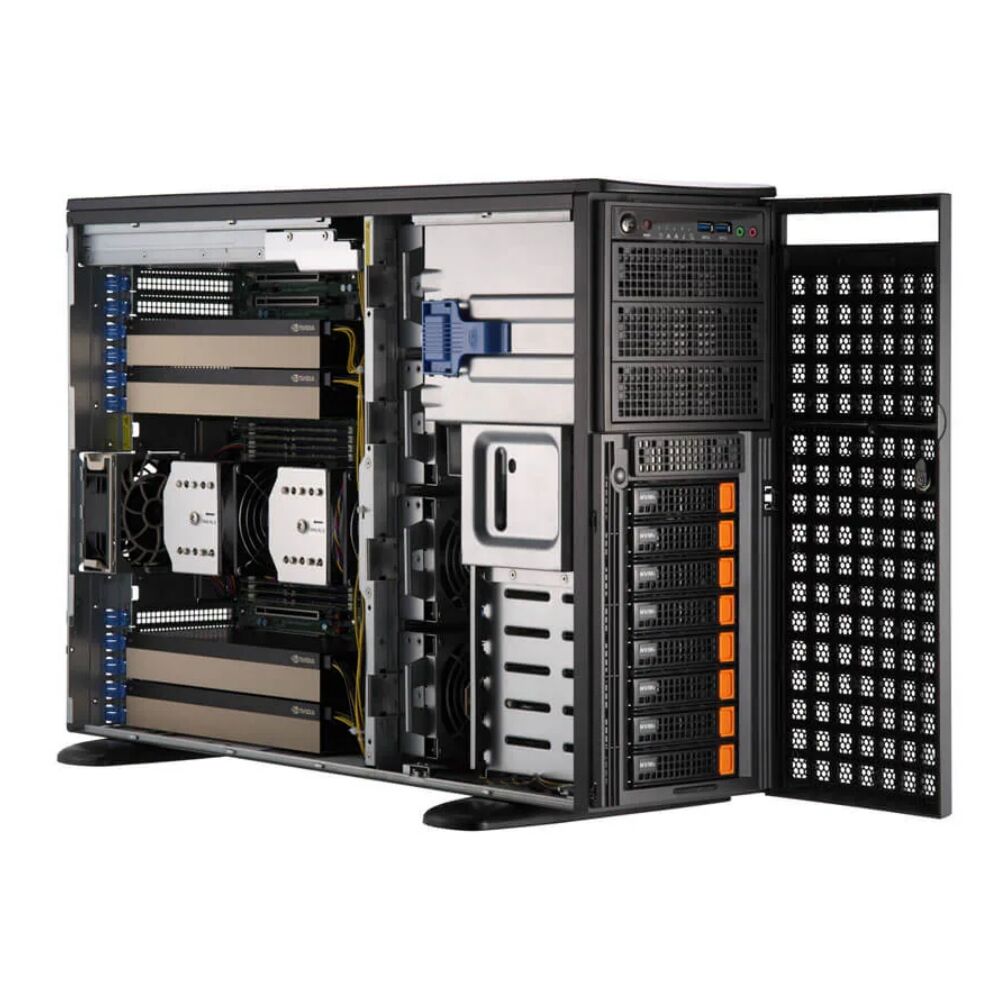
High-end workstation platforms designed for multi-GPU deployment, such as those based on server-class Intel Xeon architectures with multiple PCIe slots, provide the bandwidth, power, and thermal headroom that professional GPUs with ECC memory require. These platforms typically also include system-level ECC for main RAM, creating an end-to-end data integrity architecture where both CPU-side and GPU-side memory operations are protected against corruption.
Platform selection should also account for GPU slot configurations, PCIe generation support, and physical cooling layouts. Professional GPUs with ECC memory often have higher power requirements and larger physical footprints than consumer cards, and the workstation chassis must accommodate these characteristics without compromising airflow or power stability. Choosing a platform specifically validated for multi-GPU professional workloads eliminates the compatibility and reliability uncertainties that come with mixing professional GPU hardware with consumer-grade system platforms.
Evaluating Long-Term Total Cost of Reliability
Professional GPUs with ECC memory carry a higher acquisition cost than their consumer counterparts. This premium reflects not only the ECC hardware itself but also the extended testing, qualification, longer support lifecycle, and professional driver ecosystem that accompanies these products. For mission-critical applications, this cost differential should be evaluated against the potential cost of hardware-induced errors, not simply against raw compute performance per dollar.
When a corrupted simulation result leads to a design rework cycle, a failed regulatory submission, or a misdiagnosis in a clinical environment, the cost consequences vastly exceed the price difference between professional and consumer GPU options. Organizations that evaluate their GPU procurement decisions through a total cost of reliability framework consistently find that professional GPUs with ECC memory represent a sound investment rather than an unnecessary expense.
Additionally, professional GPUs with ECC memory typically offer longer product lifecycle support, certified driver stability, and access to ISV application certifications that consumer GPUs do not provide. For organizations with multi-year deployment cycles and software environments that require certified hardware, this ecosystem support has independent value that extends well beyond the ECC memory feature alone.
FAQ
Do all professional GPUs come with ECC memory enabled by default?
Not all professional GPUs have ECC memory enabled by default, and some require ECC to be activated through driver settings or system configuration. It is important to verify both that the GPU hardware supports ECC and that it is enabled in the system software environment. When ECC is enabled, there is typically a small reduction in usable memory capacity and a modest decrease in peak memory bandwidth, which is the standard tradeoff for achieving hardware-level data integrity protection.
Can professional GPUs with ECC memory be used in workstations alongside standard system RAM?
Yes, professional GPUs with ECC memory can operate in workstations that use standard non-ECC system RAM, though this configuration does leave the CPU-side memory path unprotected. For the highest levels of end-to-end data integrity in truly mission-critical environments, it is recommended to pair professional GPUs with ECC memory with server-class or workstation-class ECC-registered DIMM system memory, creating comprehensive hardware-level protection across the entire compute chain.
How does ECC memory in GPUs differ from ECC in system RAM?
ECC memory in GPUs operates specifically within the GPU's on-board VRAM, protecting the memory used for GPU computations, texture storage, and frame buffers. ECC in system RAM protects the main memory accessed by the CPU and operating system. Both mechanisms function similarly — detecting and correcting single-bit errors — but they operate independently and protect different segments of the compute architecture. Mission-critical workstations benefit most when both GPU VRAM and system RAM are ECC-protected.
Is professional GPU ECC memory support relevant for AI and machine learning workloads?
Absolutely. AI training and inference workloads involve massive numbers of floating-point and integer operations across large memory spaces. A single undetected bit-flip during a training run could corrupt model weights and produce a subtly flawed model that performs incorrectly on edge cases. For organizations deploying AI in regulated industries — medical diagnostics, financial risk modeling, safety-critical control systems — using professional GPUs with ECC memory is not a luxury but a fundamental requirement for trustworthy model development and inference reliability.
Table of Contents
- Understanding ECC Memory in the Context of GPU Computing
- Why Mission-Critical Workstations Demand GPU-Level ECC Protection
- Practical Reliability Advantages in Specific Mission-Critical Domains
- Selecting the Right Platform for Professional GPUs with ECC Memory
-
FAQ
- Do all professional GPUs come with ECC memory enabled by default?
- Can professional GPUs with ECC memory be used in workstations alongside standard system RAM?
- How does ECC memory in GPUs differ from ECC in system RAM?
- Is professional GPU ECC memory support relevant for AI and machine learning workloads?