
 EN
EN
Choosing the right hardware stack for AI inference and training is one of the most consequential infrastructure decisions a modern enterprise can make. Unlike traditional computing workloads, AI workloads place simultaneous and extreme demands on every layer of the hardware hierarchy — from the GPU and CPU down to memory bandwidth and storage throughput. Getting even one component wrong can create a bottleneck that throttles the entire pipeline, resulting in wasted investment, slower model iteration cycles, and degraded real-time inference performance. Understanding what each hardware component contributes — and how they interact — is the foundation for building a system that truly delivers.
This article provides a detailed breakdown of the optimal hardware stack for AI inference and training, covering GPU selection, CPU architecture, memory configuration, and storage hierarchy. Whether you are deploying large language models, running computer vision pipelines, or managing distributed training clusters, the guidance here will help you align your infrastructure choices with your performance targets. The decisions you make at the hardware level determine not just speed, but cost-efficiency, scalability, and the long-term viability of your AI operations.
The Role of GPUs in AI Inference and Training
Why GPU Architecture Is Central to AI Performance
GPUs are the computational heart of any system designed for AI inference and training. Their massively parallel architecture, with thousands of CUDA or equivalent cores, allows them to perform the matrix multiplications and tensor operations that underpin neural network computations at extraordinary speed. A CPU, no matter how powerful, simply cannot match the throughput a modern GPU delivers for these specific workloads. The difference is not marginal — it is often measured in orders of magnitude.
For training workloads, raw floating-point performance — particularly in formats like FP16, BF16, and INT8 — determines how quickly gradients can be computed and weights updated. For AI inference and training serving, latency and throughput metrics become equally important, requiring GPUs with high memory bandwidth and efficient tensor cores. High-end data center GPUs with dedicated transformer engine capabilities have become the standard for production-grade deployments because they are engineered specifically for these dual demands.
The number of GPUs in a server also matters enormously. Multi-GPU configurations connected via high-speed interconnects allow models to be parallelized across devices, reducing training time and enabling larger batch sizes during inference. When evaluating any server intended for serious AI inference and training work, the GPU count, interconnect topology, and per-GPU memory capacity should all be primary selection criteria rather than secondary considerations.
Matching GPU Memory to Model Size
GPU memory — commonly called VRAM — is often the first hard constraint encountered when deploying large models. A language model with tens of billions of parameters requires hundreds of gigabytes of GPU memory just to hold its weights in FP16 format, before any activations or optimizer states are accounted for during training. Systems designed for AI inference and training at scale must therefore offer either very high per-GPU memory or the ability to distribute model weights across multiple GPUs seamlessly.
Memory bandwidth is equally critical. Even if a GPU has sufficient capacity, insufficient bandwidth will cause the compute cores to stall while waiting for data to be loaded. High-bandwidth memory technologies have been developed precisely to address this bottleneck in AI inference and training scenarios. When evaluating GPU options, the ratio of memory bandwidth to compute capacity is a reliable proxy for how well a GPU will perform on memory-bound operations, which are extremely common in transformer-based model architectures.
CPU Requirements for AI Workloads
The CPU's Supporting Role in the AI Stack
While GPUs dominate the compute-intensive phases of AI inference and training, the CPU plays an indispensable orchestration role. It handles data preprocessing, batch assembly, model loading, inter-process communication, and system-level scheduling. A weak or poorly configured CPU can starve the GPUs of data, creating a supply-side bottleneck even when the GPUs themselves have ample capacity. In high-throughput inference serving environments, the CPU also manages network I/O and request routing, making its performance directly relevant to end-user latency.
For AI inference and training servers, modern multi-core server-grade CPUs with high core counts and large last-level caches are preferred. These processors handle the parallel preprocessing tasks — tokenization, image decoding, feature extraction — that must keep pace with GPU consumption rates. High memory channel counts on the CPU side also directly affect how quickly system RAM can feed data to the GPU via PCIe or NVLink pathways.
CPU-to-GPU Bandwidth Considerations
The interface between the CPU and GPU is a frequently underestimated performance factor in AI inference and training infrastructure. PCIe generation and lane width determine how fast model inputs can be transferred from host memory to GPU memory and how quickly outputs can be returned. PCIe Gen 5 has significantly improved this bandwidth compared to earlier generations, and platforms that support it are now preferred for data-intensive inference workloads.
For multi-GPU training scenarios, the CPU also coordinates collective communication operations — all-reduce, all-gather — that synchronize gradients across GPUs. While GPU-to-GPU interconnects handle most of this traffic, the CPU's ability to efficiently initiate and coordinate these operations affects overall scaling efficiency. Choosing a CPU platform that offers robust PCIe topology and sufficient I/O bandwidth is therefore a deliberate architectural choice, not an afterthought, when designing systems for AI inference and training.
Memory Configuration for AI Servers
System RAM Capacity and Speed
System memory, or DRAM, serves as the staging area between persistent storage and the GPU during AI inference and training operations. Datasets, model checkpoints, and intermediate computation results all pass through system RAM. Insufficient RAM forces the system to swap data to disk, introducing severe latency penalties that can completely undermine the benefits of a high-performance GPU setup. For serious AI workloads, system RAM in the range of 512 GB to multiple terabytes is increasingly standard.
Memory speed and the number of active memory channels also matter significantly. DDR5 memory with high frequency and low latency has become the preferred standard for platforms built around AI inference and training use cases, offering substantially higher bandwidth than previous generations. Running memory in all available channels to maximize aggregate bandwidth is a configuration best practice that should never be overlooked when commissioning an AI server.
ECC Memory and Reliability
Error-Correcting Code memory is not optional for production AI inference and training systems. Long-running training jobs lasting days or weeks are highly vulnerable to silent memory errors — single-bit flips caused by cosmic rays or voltage fluctuations — that can corrupt model weights and invalidate entire training runs without producing any obvious error signal. ECC memory detects and corrects these errors transparently, protecting the integrity of computation at the cost of a modest performance overhead that is always worthwhile in professional deployments.
Beyond reliability, memory configuration also includes considerations like NUMA topology. In dual-socket server platforms, each CPU has its own local memory bank, and accessing the remote bank incurs additional latency. Careful NUMA-aware memory allocation ensures that AI inference and training processes access their local memory as much as possible, reducing average memory access latency across the board.
Storage Architecture for AI Data Pipelines
NVMe SSDs as the Primary Storage Tier
Storage is the layer most frequently underspecified in AI server builds, yet it directly affects training iteration speed and inference deployment agility. For AI inference and training pipelines, NVMe SSDs connected via PCIe are the minimum acceptable primary storage standard. These drives offer sequential read speeds measured in gigabytes per second, allowing large datasets, model checkpoints, and activations to be loaded into system RAM and GPU memory at rates that can keep pace with compute demand.
The number of NVMe drives and their RAID or striping configuration also determines peak throughput. Training on large vision datasets or multi-modal corpora requires sustained sequential read performance that a single NVMe drive cannot always provide. Deploying multiple NVMe drives in a software RAID-0 or hardware striping configuration multiplies available bandwidth, ensuring the storage subsystem never becomes the limiting factor in AI inference and training workflows.
Storage Capacity Planning and Tiering
Beyond performance, capacity planning is a serious concern for teams engaged in ongoing AI inference and training projects. Large language model pretraining datasets can span tens of terabytes, and checkpoint storage for long training runs can accumulate rapidly. A well-architected AI server storage strategy typically involves a fast NVMe tier for active training data and checkpoints, complemented by a high-capacity SSD or HDD tier for archival storage of completed experiments and raw datasets.
For inference serving, storage speed affects model load time, which determines cold-start latency. In environments where models are loaded on demand — as in serverless inference deployments or multi-model serving systems — fast NVMe storage directly reduces user-facing latency. A AI inference and training platform with a well-matched storage stack minimizes these cold-start penalties and supports higher model concurrency without storage-related delays.
Integrating the Full Hardware Stack for Maximum Performance
Balanced System Design Principles
The highest-performing hardware stacks for AI inference and training are not simply collections of the best individual components — they are carefully balanced systems where each layer is sized to match the throughput capacity of the others. A system with eight high-end GPUs but only four PCIe lanes per GPU, or with insufficient CPU cores to handle preprocessing, will deliver far below its theoretical peak. Balance is the operative principle, and it requires system architects to model the data flow from storage through memory, CPU, and finally GPU before finalizing specifications.
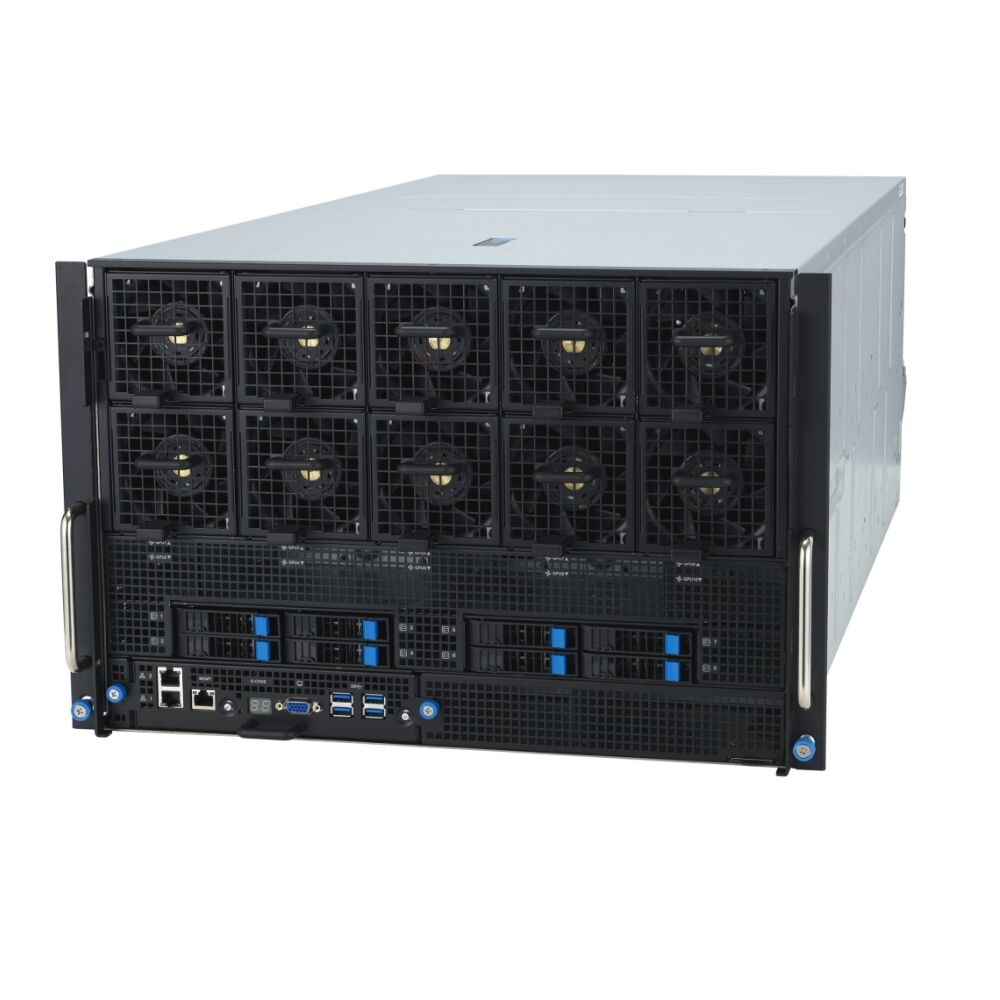
Thermal design is another integration factor that is easy to overlook until it causes problems. High-density GPU configurations generate substantial heat, and inadequate cooling throttles GPU clock speeds, reducing effective compute throughput. Rack-mounted AI servers designed for AI inference and training at scale incorporate high-airflow chassis designs, redundant power supplies, and thermal management systems that maintain component temperatures within optimal operating ranges even under sustained full-load conditions.
Scalability and Future-Proofing the Stack
AI models are growing in size and complexity at a rapid pace, and hardware investments must be evaluated not just for current needs but for their ability to scale. Platforms that support GPU upgrades, additional memory DIMMs, and NVMe expansion without requiring a full system replacement offer significantly better total cost of ownership for teams engaged in long-term AI inference and training research and deployment. PCIe expansion slots, open storage bays, and modular power delivery architectures are all signs of a platform designed with scalability in mind.
Network interconnect is also part of the full stack consideration for distributed AI inference and training deployments. High-speed InfiniBand or RDMA-capable Ethernet enables multi-node training, allowing workloads to scale beyond the capacity of a single server. Planning for network-attached storage access and inter-node gradient communication from the outset prevents costly retrofits as the scale of AI operations grows.
FAQ
What is the single most important hardware component for AI inference and training performance?
The GPU is the most critical single component for AI inference and training because it performs the vast majority of the actual computation. However, it cannot deliver its potential without sufficient system RAM, fast storage, and a capable CPU to keep it fed with data. Treating the GPU as the only important component leads to imbalanced systems that underperform their specifications.
How much system RAM is recommended for AI inference and training servers?
For serious AI inference and training workloads, a minimum of 256 GB of ECC DDR5 system RAM is advisable, with 512 GB or more preferred for large-scale training on multi-modal or large language model architectures. The exact requirement depends on dataset size, batch size, and whether the system is used primarily for training, inference, or both.
Does storage speed really affect AI inference and training performance?
Yes, significantly. Storage speed affects how quickly training data can be loaded per iteration, how fast model checkpoints can be saved and restored, and how rapidly models load during inference. Slow storage creates I/O wait states that prevent GPUs from operating at full utilization during AI inference and training, directly reducing effective throughput and increasing training wall-clock time.
What CPU features matter most for AI inference and training server platforms?
For AI inference and training platforms, the most important CPU features are high core count, support for many memory channels, PCIe Gen 5 connectivity, and large last-level cache. These characteristics ensure the CPU can efficiently manage data preprocessing, GPU communication, and system orchestration without becoming a bottleneck in the AI compute pipeline.
Table of Contents
- The Role of GPUs in AI Inference and Training
- CPU Requirements for AI Workloads
- Memory Configuration for AI Servers
- Storage Architecture for AI Data Pipelines
- Integrating the Full Hardware Stack for Maximum Performance
-
FAQ
- What is the single most important hardware component for AI inference and training performance?
- How much system RAM is recommended for AI inference and training servers?
- Does storage speed really affect AI inference and training performance?
- What CPU features matter most for AI inference and training server platforms?